The Business Problem
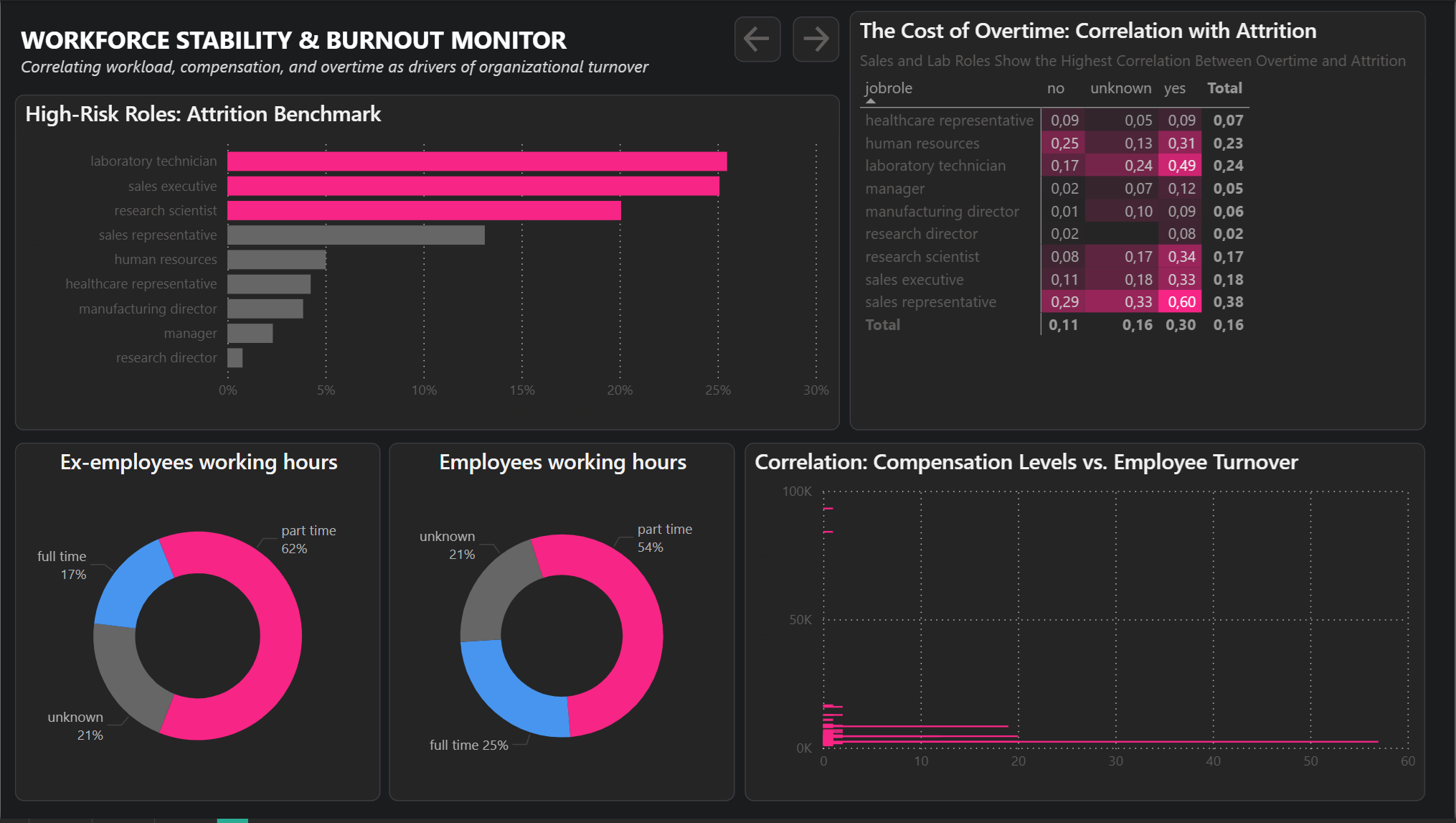
Employee turnover is one of the most expensive and preventable challenges organisations face. ABC Corporation had a 16% global attrition rate — and 259 high-performing employees had already left, representing an estimated replacement cost of $22,122,795.
The question wasn’t just “who is leaving?” but “what is the organisation doing — or not doing — that is driving them out?”
Approach & Technical Execution
This was an end-to-end group project completed in 3 weeks, covering the full analytics pipeline:
Data processing: Python (Pandas, NumPy) for data cleaning, feature engineering, and exploratory analysis. SQL queries to validate data integrity and cross-reference behavioural patterns across employee segments.
Analysis: Descriptive statistics and correlation analysis across variables including overtime, compensation, promotion history, stock options, travel frequency, contract type, and distance to work — identifying which factors most strongly predict attrition.
Visualisation: Multi-page interactive Power BI dashboard (DAX, Power Query) designed for HR leadership — translating complex multivariate findings into role-by-role attrition benchmarks with drill-down capability.
Key Findings
Who is leaving — and why
Overtime is the strongest structural driver of churn. Sales Representatives showed the highest attrition rate (37.8%) and the highest proportion of overtime hours. The correlation between excess workload and turnover holds across roles — the more overtime, the higher the exit rate.
Professional stagnation is equally critical. Employees who go 4+ years without a promotion show significantly higher attrition — even those with high stock option levels. Among top performers with maximum benefits, the probability of leaving spikes sharply after 4–5 years without career progression.
Part-time employees represent 62% of churned staff, pointing to structural instability in non-standard contracts — lower benefits, fewer development opportunities, and weaker organisational attachment.
Compensation alone does not predict turnover — but relative positioning within a pay band does. Employees with below-average salary increases for their performance rating are significantly more likely to leave than peers at the same performance level.
Distance to work matters from 12km onwards. Employees living further away show higher attrition, while those living nearby tend to stay. Remote work availability does not offset this effect significantly.
The Talent Abyss — the highest-risk segment
The analysis identified a critical employee segment combining:
- High performance rating (≥3)
- Zero stock options
- 4+ years without promotion
- Low work-life balance
This group shows a 31.82% attrition rate — the most costly profile to lose and replace.
A secondary high-risk segment (performance ≥3, no stock options, 4+ years without promotion) shows a 23.57% attrition rate.
Additional patterns
- The 18–22 age bracket has by far the highest attrition rate, tapering significantly from 38 onwards.
- Human Resources and Laboratory Technicians are structurally under-promoted relative to their attrition risk.
- Frequent business travel correlates with higher turnover in high-performers, even though it does not directly correlate with lower satisfaction — suggesting the issue is lack of recognition or compensation for travel burden, not the travel itself.
Recommendations
The analysis surfaces five priority actions for HR leadership:
- Promotion pipelines for high-risk roles — Sales Representatives, Lab Technicians, HR, and Research Scientists need structured career paths with defined timelines.
- Stock option review for high performers — incentive allocation should account for performance trajectory, not only seniority.
- Overtime audit in Sales — headcount or workload redistribution to reduce the structural burnout driving the highest-attrition role in the company.
- Travel compensation policy — frequent travellers in high-performance roles need explicit recognition; data on actual travel costs and compensation is currently missing.
- Hybrid work for employees beyond 15km — distance-related attrition is addressable with remote flexibility, particularly in roles where it is operationally viable.
Open Questions
The analysis also surfaces data gaps that limit current conclusions:
numberchildrencolumn contains no data — family care dynamics remain an untested hypothesis- No data on internal compensation vs. market benchmarks — external competitiveness by role is unknown
- No breakdown of workload beyond overtime hours — volume and complexity of tasks not captured
Stack
Python Pandas NumPy SQL Power BI DAX Power Query