The Project
The Spanish labour market is opaque. Salaries are rarely disclosed, what is actually required in technical roles is buried in unstructured text, and the way automation and AI regulation are reshaping demand is unevenly documented. This project measures that with real job-posting data and, just as importantly, documents the whole pipeline with governance criteria, treating the process itself as the deliverable, not only the analysis.
It is deliberately built as a demonstration of DAMA/CDMP practice. Every extraction, cleaning and scope decision is recorded as it is made, with its rationale, so the repository reads as evidence of how data is governed, not just what was found.
This is an in-progress project. This page documents the foundation and extraction work completed in Phase 1. Analysis and public findings will be added as the project advances.
Approach & Technical Execution
Phase 1: Foundation, Extraction & Governance (in progress)
The current phase establishes a reproducible, fully documented extraction pipeline before any analysis is run. The sequence matters, because a governed pipeline is what the project is meant to demonstrate.
-
Source and scope defined deliberately. Job postings are retrieved from the Adzuna API (Spain) by category, not by free-text keyword. An early exploratory version used keyword search. It was replaced because the search universe then depended on individual word choice and missed bilingual variants: a search for “data” misses “datos”, “rrhh” misses “recursos humanos”. The category-based universe is stable and documentable, with four in-scope categories (
it-jobs,hr-jobs,legal-jobs,consultancy-jobs), each chosen for a stated reason, and two categories excluded on purpose and logged as a Phase 1 limitation. -
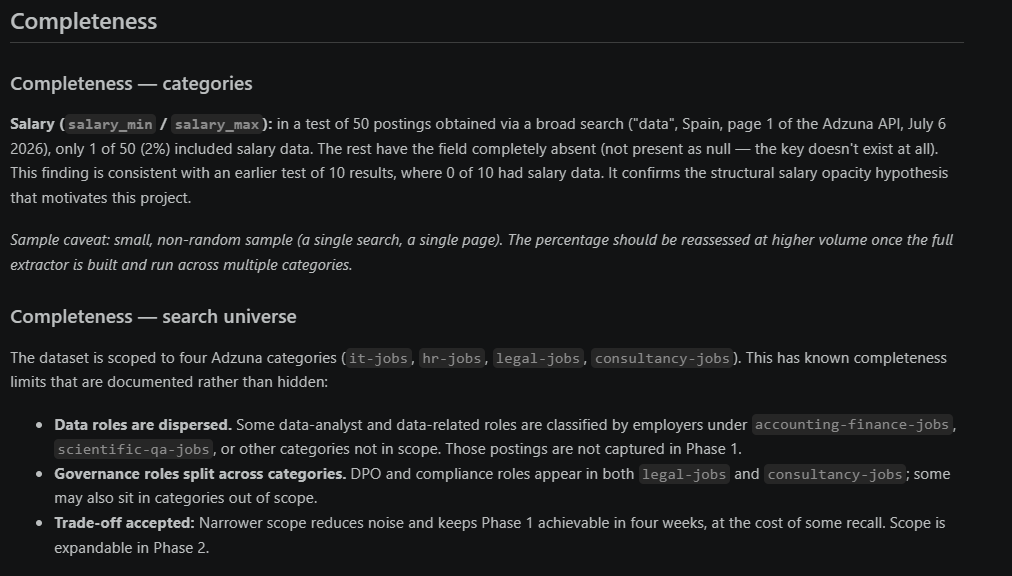
Extraction validated against reality, not documentation. Before building the full extractor, test calls confirmed what Adzuna actually returns, which does not fully match its public docs. This surfaced the project’s central empirical finding early: salary data is present in roughly 2% of postings, confirming the structural salary-opacity hypothesis that motivates the whole observatory. Geographic coordinates appear in only around 50% of postings, and the
descriptionfield is a truncated snippet rather than the full text. -
First full extraction complete. Around 1,000 raw postings extracted across the four categories (5 pages by 50 results per call, the Adzuna maximum), saved as immutable timestamped JSON with an integrity check confirming no pages were lost. Raw data is never edited by hand, following a strict extract, transform and load separation.
Phase 2 onward (planned)
Cross-source analysis with INE-EPA microdata and the ILO AI-exposure index, a sector-by-sector regulatory table mapped to the EU AI Act, pipeline automation, and a Looker Studio dashboard.
Governance Decisions Made
The point of the project is that these are documented as they happen, not reconstructed at the end:
- Data Dictionary. Every extracted field is defined empirically, including its real presence rate and known limitations: sparse salary, inconsistent coordinates, truncated descriptions.
- Data Quality Dimensions (DAMA). Completeness is written up with its own trade-offs (dispersed data roles, governance roles split across categories), alongside an extraction-integrity check, and accuracy is documented for partial geocoding.
- Data Lineage. A chronological record of every pipeline event and decision, including the discarded keyword-search approach, retained deliberately: the raw files were deleted, but the reasoning is kept.
- Two-tier confidence for text analysis. A methodological decision to report keyword mentions from truncated descriptions as an explicit lower bound, kept separate from high-confidence structured-field analysis, rather than presenting one blended figure.
What’s Built So Far
- Repository scaffolding with an extract, transform and load structure and a documented Python virtual environment
- Adzuna API integration validated, with the category catalogue downloaded and stored as reference evidence of the inclusion criteria
- Around 1,000 postings extracted and organised, with test and reference data separated from the active pipeline for transparency
- Three core governance documents (data dictionary, data quality, data lineage) written and kept current with every decision
Stack
Python Pandas SQL BigQuery Adzuna API Looker Studio