The Project
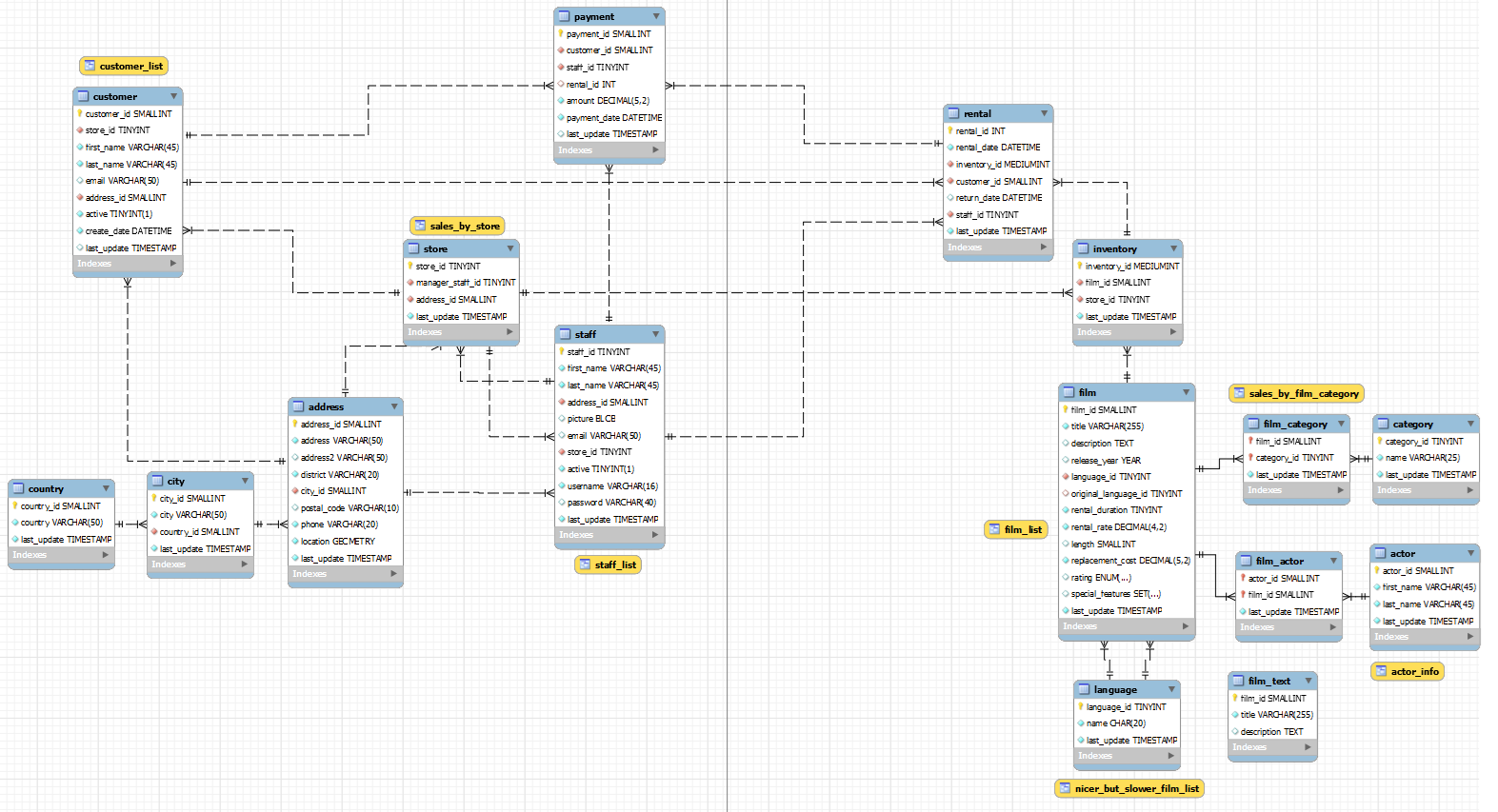
Sakila is MySQL’s canonical sample database: a movie rental business with 16 related tables covering films, actors, customers, inventory, rentals, payments, and staff. This assessment uses it as a substrate for demonstrating SQL fluency across increasing levels of complexity — from single-table queries to four-way JOINs and correlated subqueries.
Approach & Technical Execution
Scope of the assessment
24 exercises structured around three levels of complexity:
- Filtering and retrieval —
DISTINCT,WHERE,LIKE,BETWEEN,NOT IN,REGEXP - Aggregation —
COUNT,AVG,GROUP BY,HAVING,ROUND - Multi-table logic —
INNER JOIN,LEFT JOIN, subqueries withINandNOT EXISTS,DATEDIFF
Notable technical decisions
For exercises where multiple approaches were valid, both were implemented and compared. Exercise 14 — finding films with “dog” or “cat” in the description — includes a LIKE solution and a REGEXP alternative, with a note on when each is preferable. Exercise 23 — actors who have never appeared in a Horror film — is solved twice: once with NOT IN and a derived set, once with NOT EXISTS and a correlated subquery, which performs better on large datasets by short-circuiting evaluation per row.
The intermediate queries are preserved alongside final queries throughout the file. This reflects the actual working process: exploring table structure, verifying joins before aggregating, and confirming results before trimming columns. The exploratory steps are part of the work, not noise to be removed.
Multi-table JOIN chain (Exercise 11)
Rental counts by category required traversing four tables — rental → inventory → film_category → category — with no direct key between rentals and categories. Building the chain in stages, verifying intermediate results at each join, confirmed the logic before applying GROUP BY.
Key Queries
Rentals per customer with customer details — LEFT JOIN between customer and rental preserves customers with zero rentals, rather than silently excluding them.
Films rented for more than 5 days — subquery isolates rental_ids where DATEDIFF(return_date, rental_date) > 5, then the outer query joins to film titles. Separation of concerns: the duration logic stays contained.
Actors not in Horror films — NOT EXISTS with a correlated subquery is semantically cleaner than NOT IN when the excluded set could be large or contain NULLs, which would cause NOT IN to return no results.
Average film length by category, filtered to >120 min — HAVING rather than WHERE, since the filter applies to an aggregate computed after grouping, not to individual rows.
Stack
MySQL Sakila Database